Who doesn't want to be remembered after they are gone?
There is something in our human nature that wants validation for our lives and how we lived them. It's why High School hallways are filled with trophies, yearbooks are filled with notes about how we "will never forget you," and why churches put brass nameplates on everything. We want to be remembered.
The question is: Do we do anything WORTHY of being remembered?
Well before we get to that, let's think about the things that get remembered.
--Sports statistics- but really only by guys, and not all of them at that.
--Major historical accomplishments that shape the world- but then, just watch Jay Leno's Jaywalking segments to see even that doesn't hold up.
--Be famous- quick, name the star of the number 1 television show in 1983. Thought so.
--Invent something-Who invented the electric light? Nope, not Edison, some dude named Humphry Davy. Yeah, had to Google that myself.
Okay, so doing important stuff doesn't necessarily leave a legacy. Now, think of one person who made a difference in your life. No doubt you have a dozen or so names flash through your mind- that teacher that took an interest in you, that boss who saw your talents and grew them, the person who spoke openly to you about Christ, a parent. You may not remember Humphry Davy, but you will never forget the people who engaged you in your life.
It's relationships. These are the things that make legacies. Paul, in his second letter to Timothy, mentions that Timothy's faith is one of legacy- first in his grandmother, then his mother, then Paul himself. You are who you are because of a lot of experiences, and because of the people you share them with.
So, the original question- What are you doing in your relationships with others that is worthy of a Legacy?
We celebrate accomplishments and donations- but we don't commemorate the impact people make on us personally with trophies and plaques. And we shouldn't. Legacy is passed on not in possessions, but in wisdom, encouragement, love, and so many other hard to calculate things. The way we know we are the part of the legacy of someone is if they left their mark on us.
For us to leave a legacy, we need to leave a mark. We need to live lives that matter to people outside of ourselves. And- in total antithesis to our nature- we need to do it not for our own self aggrandizement, but for the well being of others.
Paul is a great example of this self-sacrificial nature. In Romans 9, he says he would go to Hell if it meant his fellow Hebrews would accept Christ. But he also gives us a great picture of a legacy we should all aspire to in Acts 20:25-27
“Now I know that none of you among whom I have gone about preaching the kingdom will ever see me again. Therefore, I declare to you today that I am innocent of the blood of any of you. For I have not hesitated to proclaim to you the whole will of God.
Paul's legacy was that he told everyone about Christ. Everyone. He lived in such a way that people knew who he followed, and he was never shy about proclaiming it.
The fact is- someone shared Christ with you. Someone prayed for you. Someone gave you a Bible. Someone invited you to church one night. Someone talked with you when you were struggling with doubts and fears and failures and all sorts of other junk. They gave of themselves to you, so you would make right choices and grow stronger. You are their legacy.
And that's how you grow yours.
Monday, September 19, 2011


Wednesday, September 7, 2011
Combustible Drought
This is Texas now.
For the last year or two, we've been in a drought. Here in Bryan/College Station, for the year to date, we are over 20 inches behind on the wet stuff. We were about that much behind last year. What this means is a warm breath can start a fire.
This extreme drought is paralyzing. It is destroying crops, killing livestock, and putting ranchers in binds that point toward bankruptcy. But until the fires, there was very little mention of it in the media outside the local stations. Droughts just aren't as interesting Severe Weather Phenomenons as, say, a Hurricane on the east coast. Video of large cracks in dry black dirt is nowhere near as interesting as a weatherman being pummeled by storm surge.
The fires changed that. Now, people are talking. Now, the drought matters.
Because the drought is a constant thought these days, I had been thinking a lot about that Psalm that talks about the deer panting for water- Psalm 42, it turns out. I took the time to read it the other day, and it struck me how closely the drought for my state parallels those droughts we all experience spiritually. Just look at the first four verses:
1 As the deer pants for streams of water,
so my soul pants for you, my God. 2 My soul thirsts for God, for the living God.
When can I go and meet with God?
3 My tears have been my food
day and night, while people say to me all day long,
“Where is your God?”
4 These things I remember
as I pour out my soul: how I used to go to the house of God
under the protection of the Mighty One
with shouts of joy and praise
among the festive throng.
Texas is begging for rain, and it's not uncommon to hear folks talking wistfully about rains of the past. Talk to someone in a spiritual drought, and it's a similar deal. "Man, that time when God..." or "I remember once, we were singing this song, and God showed up." There is a mournful, longing tone to the voices that speak of these things long gone.
The thing I find interesting about Psalm 42 is that David is not feeling distant from God, yet he feels like he is in spiritual drought. Verse 8 says, "By day the LORD directs his love, at night his song is with me— a prayer to the God of my life." (Emphasis mine). But then, in verse 9: I say to God my Rock, "Why have you forgotten me? Why must I go about mourning, oppressed by the enemy?” God is with David, yet David feels like God has forgotten him. Why this paradox?
How often have you had moments of clarity in the midst of turmoil? Or, moments of self-pity in the midst of mountain-top elation? God is EVER present, yet we can still feel distant. We may be praying, reading His Word, singing His praises- yet feel dry, distant, and like it's all a lot of hard work for a moment of connection.
Like droughts, this is a natural- if unfortunate- thing.
The problem with spiritual drought is when it becomes combustible drought. When the work we put in to connect with God becomes 'too hard,' we begin to give up. We lose hope. We stop reminding ourselves as David did in verse 11: Why, my soul, are you downcast? Why so disturbed within me? Put your hope in God, for I will yet praise him, my Savior and my God.
Then, the fires of temptation spark, and we are consumed. Like the fire in the video above. I believe, from personal experience, that a loss of hope dramatically increases the chance for sin. Loss of hope is like the "Red Flag Warning" we get here in Texas when the drought is high and the winds are strong. Fire danger is high.
Fortunately for us, we can stave off the spiritual fires of temptation much easier than the wildfires that have ravaged Texas. We can't make it rain on our Terra Firma- but we can seed our spiritual clouds by listening to what David says in verse 11-Put your hope in God, for I will yet praise him, my Savior and my God. It seems simple, maybe too simple, but the remedy for a loss of hope is to hope. Stubborn, unmovable hope. Fleeting hope is no hope at all. No, we must hold to a hope that is made of stronger stuff than the 'wishful thinking' kind of hope most of live by. Our hope cannot be in lesser things, but only in the God who is still there, still saving us.
Still pouring water on our combustible drought of the soul.
Let us also pray for those who are affected by the physical drought and terrible fires. As they watch their homes be threatened or destroyed, they no doubt wonder where God is in all this- why them? I, nor anyone else on this planet, can answer that. Their spiritual drought is nearing the same level of combustion as the grasses and trees around their homes. Let us intercede, let us offer them the stubborn hope we are clinging to, let us hope when they haven't the strength to do it themselves. Let us pray to our God the Rainmaker, the Drought-Ender.
Let us be more like David- who senses God's nearness, yet longs ever more for the cooling drink from the presence of God.
Monday, August 29, 2011
Choose Wisely
Today is the first day of the Fall 2011 semester for THOUSANDS of students at Blinn and A&M here in Bryan/College Station. For some the excitement is palpable, for others, it's more a sense of dread. But mostly the excitement.
Especially for freshmen. Today, it is official. You are gaining independence. Sure, Mom and Dad dropped you off sometime in the last week, stocked up your mini-fridge, cast a wary eye toward your roommate, and made sure you had all your supplies- then headed home to redecorate your room. And you had a week of real freedom. Today, you have class. And no one is there to wake you up, make your breakfast and get you there.
Today is the first day of many choices you'll face. Go to class, or sleep in. Buy the books, or fake it and hope the tests are lecture based (if you choose to go to class, of course). Stay out late, or get plenty of rest. Can I beat that bus on my bike, or does a semester in traction sound good?
But there are more serious questions. Questions like: Who will I become now that I am gaining independence? What are my limits? Is this really the field of study I want to spend my life in? What is my spiritual journey going to look like?
Joshua 24:14-15 is about choices. In this speech, Joshua, the leader of Israel after Moses, gives a sort of commencement address, and concludes with this:
“Now fear the LORD and serve him with all faithfulness. Throw away the gods your ancestors worshiped beyond the Euphrates River and in Egypt, and serve the LORD. But if serving the LORD seems undesirable to you, then choose for yourselves this day whom you will serve, whether the gods your ancestors served beyond the Euphrates, or the gods of the Amorites, in whose land you are living. But as for me and my household, we will serve the LORD.”
Joshua gives the call: Choose to give God all of your faithfulness, or give it up. No room for wafflers, no room for indecision. You can worship these old-time gods, or defeated gods, or you can serve the Lord. Either way they chose, Joshua made it clear where he was going.
Now, I don't want to get all moralistic on you, but I want you to understand this basic ideal:
Just because it looks good, doesn't mean it is.
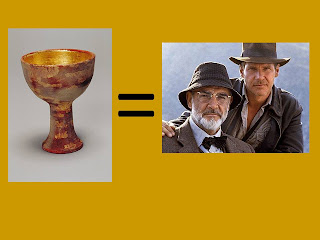
Case in point, Indiana Jones and the Last Crusade features the perfect example. Choose the right Holy Grail, get eternal life. Choose the wrong and you die. Fast. The Nazi picks a bejeweled golden chalice because "Jesus was the King of Kings." Well, Nazis are bad guys, so you know how this ends:

And just because a church is feeding you tons of free food and has boatloads of money to spend on awesome programs doesn't mean they are a bad church. Nor does it mean they are a good church. Just because a church is small like you're used to, and comfortable with, doesn't mean it's the right church for you.
Choose Wisely.


Especially for freshmen. Today, it is official. You are gaining independence. Sure, Mom and Dad dropped you off sometime in the last week, stocked up your mini-fridge, cast a wary eye toward your roommate, and made sure you had all your supplies- then headed home to redecorate your room. And you had a week of real freedom. Today, you have class. And no one is there to wake you up, make your breakfast and get you there.
Today is the first day of many choices you'll face. Go to class, or sleep in. Buy the books, or fake it and hope the tests are lecture based (if you choose to go to class, of course). Stay out late, or get plenty of rest. Can I beat that bus on my bike, or does a semester in traction sound good?
But there are more serious questions. Questions like: Who will I become now that I am gaining independence? What are my limits? Is this really the field of study I want to spend my life in? What is my spiritual journey going to look like?
Joshua 24:14-15 is about choices. In this speech, Joshua, the leader of Israel after Moses, gives a sort of commencement address, and concludes with this:
“Now fear the LORD and serve him with all faithfulness. Throw away the gods your ancestors worshiped beyond the Euphrates River and in Egypt, and serve the LORD. But if serving the LORD seems undesirable to you, then choose for yourselves this day whom you will serve, whether the gods your ancestors served beyond the Euphrates, or the gods of the Amorites, in whose land you are living. But as for me and my household, we will serve the LORD.”
Joshua gives the call: Choose to give God all of your faithfulness, or give it up. No room for wafflers, no room for indecision. You can worship these old-time gods, or defeated gods, or you can serve the Lord. Either way they chose, Joshua made it clear where he was going.
Now, I don't want to get all moralistic on you, but I want you to understand this basic ideal:
Just because it looks good, doesn't mean it is.
Case in point, Indiana Jones and the Last Crusade features the perfect example. Choose the right Holy Grail, get eternal life. Choose the wrong and you die. Fast. The Nazi picks a bejeweled golden chalice because "Jesus was the King of Kings." Well, Nazis are bad guys, so you know how this ends:

So, Indy goes. He picks a simple cup, not ornate, kinda ugly. Because he reasoned, "Jesus was a carpenter." So that result was better:

You will face countless choices that look good, say all the right things, give you lavish gifts, and have all the right moves. But drinking from them leave will leave you hollow, empty, and potentially the spiritual equivalent of a dry, dusty old Nazi skeleton. This is true of the day to day choices you'll face, as well as the moral, spiritual, and ethical choices.
It is also true of the church and/or religious organization you choose.
Before I start- I am not bashing churches. OK, well I am kinda bashing spiritually dead/misleading churches. But what I'm about to say applies to good churches as well- and in BCS, there are hundreds of those. The point is this: Don't get caught up in all the flashy, free-gift-giving, put-on-a-production stuff you'll see over the next month or so from a lot of churches. Look past all that to the heart of the church. Don't just listen to the things the church says, watch what it does.
And just because a church is feeding you tons of free food and has boatloads of money to spend on awesome programs doesn't mean they are a bad church. Nor does it mean they are a good church. Just because a church is small like you're used to, and comfortable with, doesn't mean it's the right church for you.
Choose Wisely.
The key to living this way is in Joshua's words- "Now fear the LORD and serve him with all faithfulness." To find the right place to belong, to worship and to server, you have to trust God totally. Honestly, to keep with Him throughout your life, you must trust Him fully. Every choice you make needs to be made in light of Christ- what would He desire of you? That's what 'serving with all faithfulness' is about. It's not about sheltering yourself from the world, or denying yourself the experience of college, or choosing the hippest church. It is about seeking God's wisdom first in all you do, and then following His words through to the end.
And when it comes to churches- seek the church that God is moving and working in, no matter what it looks like on the outside. And if you belong to a church, then you need to make it your goal to aid in anyway to be the church God is moving and working in. After all, this is not all there is to the church:

This is the church:

Tuesday, August 23, 2011
How Do You Define Purity?

You ever had someone tell you not to think about a pink elephant?
Or tell you that whatever you do, do not scratch your nose?
The funny thing is, as soon as you are told to avoid those things, its all you can think about. It's basic psychology really, the more we are told what not to do, the more we want to do it. Maybe 'basic psychology' is the wrong terminology- 'basic human nature' is better. It seems since the beginning of recorded history, we go out of our to do what we are told not to do. It's more than John Locke from Lost screaming, "Don't tell me what I can't do!" out of hurt pride, it's about curiosity, about testing ourselves, about feeding something inside us.
No where has this been more evident, I believe, than the Purity movements. True Love Waits was the most known in my circles, and it was a good program. Well, it's heart was in the right place. The problem with many of these things is they spend a good portion of their time telling students of the evils of sex outside of marriage. (Sexual purity is really just a small part of the larger Purity picture, but it gets the lion's share of attention.)
Numerous studies have appeared indicating that True Love Waits and other abstinence programs aren't working so well. What has happened with that data is that lots of folks are jumping to the conclusion that it is impossible for people to abstain from sex until they are married. The taboo or "No" action is just too tempting, they would say.
And they are not wrong.
Well, not totally. The truth is, in the current way we deal with all areas of purity- not just sexual- the focus is on what NOT to do, instead what TO do. We have advertised and promoted how bad an action is, and we have made it magnetically attractive to that basic human nature that wants to do what someone has told it it can't do. Our system is doomed to fail.
Now, a system that is working right now is gold. I know, you're wondering what the heck gold has to do with purity, other than some of those rings are made of it. Here's the thing about gold- people want it pure. Pure gold is a - forgive the pun- goldmine right now. An ounce is worth more than $1800 an ounce. Everyone is talking gold. No one is talking about the stuff that was melted out of the gold.
"There are just over 30 grams in a Troy ounce, and at 5 grams/ton, you're looking at 30 divided by 5 or 6 tons of ore to recover that (Troy) ounce of gold from ore with a grade of 5 grams/ton."
(http://wiki.answers.com/Q/How_many_tons_of_ore_contain_one_ounce_of_gold#ixzz1VrMRJtP4)
There is 5 or 6 TONS of other junk (depending on the grade of the ore) that must be smelted away to get the good stuff- the pure stuff. My point is this- the focus with gold is on the pure stuff, not the stuff that gets in the way of the pure stuff. The reason is that the gold is what we value vastly more than the rest of the ore.
The problem with the call to purity in the church is not that we are calling for it, it is that we are calling for it in the negative, by telling you all about the 5 or 6 tons of junk you need to get rid of, instead of elaborating on the ounce of purity that is so valuable. We spend more time praying against the sins in our lives than we do praying for the purity.
We have place our emphasis on the lesser thing.
It is not the things taken away from a nugget of gold that make it pure, the gold's purity is an intrinsic thing. You just have to get the other stuff out of the way to see it.
True purity is not defined by what we need to lack, but by what we need to possess that is of true value.
Matthew 5:8 tells us: "Blessed are the pure in heart, for they will see God." Here is the call to purity I want to embrace. That if I seek purity, that gold amidst the mess, then I will see God. The promise is not that I will be master over my desires, that will be able to check off a list of things I don't do. The promise is a positive- that I will see God. That I will be in His presence, that I will know Him more purely.True purity is not defined by what we need to lack, but by what we need to possess that is of true value.
I believe that when we are living to seek God, the sins we worry about, the things that keep us impure, they will be burned away more and more by His presence. We do need to be aware of our sins, and acknowledge them.
But we need to focus more on God, than on them.
Wednesday, August 17, 2011
"How has attending this church changed you?"--Impact Questions
I just finished going to the Impact Ministry Fair- part of a incoming freshmen ministry (http://impactretreat.com/) that acts as a Christian Fish Camp (http://fishcamp.tamu.edu/) for students coming to A&M and Blinn. Around 1500 students come seeking a connection with God, and through the ministry fair held on the third day, to connect with local churches and religious organizations. There are three sessions, and I went to the first and third.
And met a lot of people.
One guy hugged me.
It was awkward.
But the most interesting thing, aside from seeing the student's faces grow with excitement the more they mingled the room, was the questions. They ranged from practical, to theological, to (at least to me) funny. Some of my favorites:
-Do you guys meet in a bar on purpose, or was there just nowhere else you could go?
-Do I have to be 18 to attend your church? Cuz I'm only 17.
-Is your church only for people a certain age- cuz it's in a bar?
-So, are you a church or what?
But my favorite isn't really funny. In fact, it caught me by surprise. It took me a second to respond, because I had never had this question asked of me- ever. Not about any church I'd attended or served at. And it should be asked. Often.
How has attending this church changed you?
Now, I'm pretty sure the student thought I was a student also- I get that sometimes- so my initial response was to clarify just who I was (yeah, that was kinda prideful, sorry). "Well, I started the church, so that was kinda a big change."
Now, I realized that was a ridiculous non-answer, and would help this student nary a bit in his search for a church home. So, I followed up with how God has taught me patience, perseverance and to trust in Him. I related stories of how our initial expectations went unmet and we had to lean on God and His timing- which was much slower than we liked. I told of how we were often surprised how God did work. We talked for a few minutes, then he went on his way. I was left thinking about that question.
How has attending this church changed you?
The more I've thought about it, the more I realized just how much the Gate has changed me. It's made me more diplomatic in dealing with people, but also strengthened my desire to never compromise the Gospel. It's made me realize how much I love getting one on one with people and really talking God and our lives-the personal, deeper stuff. It has made me hate apathy in my own life and the lives of those I care about so much more. I've changed the way I view church, and it seems year by year I shed old formulas and start approaching it more freely.
Now, I say it's the Gate that's made these changes- but the Gate and its people are merely the tools, the instruments God uses to mold me. Just like any church. But, the question is still a sound one, and one that we all need to ask ourselves about own church.
How has attending this church changed you?
If you can't answer that- it's time to evaluate. Churches exist to worship and spread the message of God. Inherent in the message of Christ is that we grow and we change. This change is facilitated primarily by the work of the Holy Spirit, but also by the work of the church and our own realizations and acceptance of what God is doing. If you honestly can't say how attending your church has changed you- you need ask two questions: 1) What's wrong with me? And 2) What's wrong with my church? The follow up to both of those is What can I do to change the problem? If it's you- seek God for His insight on what's wrong with you- your failings you can't see. If it's the church, seek God's wisdom on how to lead out in fixing the situation. And with the church- exhaust every effort to reconcile and heal the church- leaving is a last resort. It is because it will do just as much damage to you as it will the church. Churches- even broken ones- need people who are seeking God to make it all right.
So, I leave you with the question- and I hope you can answer it:
How has attending your church changed you?

And met a lot of people.
One guy hugged me.
It was awkward.
But the most interesting thing, aside from seeing the student's faces grow with excitement the more they mingled the room, was the questions. They ranged from practical, to theological, to (at least to me) funny. Some of my favorites:
-Do you guys meet in a bar on purpose, or was there just nowhere else you could go?
-Do I have to be 18 to attend your church? Cuz I'm only 17.
-Is your church only for people a certain age- cuz it's in a bar?
-So, are you a church or what?
But my favorite isn't really funny. In fact, it caught me by surprise. It took me a second to respond, because I had never had this question asked of me- ever. Not about any church I'd attended or served at. And it should be asked. Often.
How has attending this church changed you?
Now, I'm pretty sure the student thought I was a student also- I get that sometimes- so my initial response was to clarify just who I was (yeah, that was kinda prideful, sorry). "Well, I started the church, so that was kinda a big change."
Now, I realized that was a ridiculous non-answer, and would help this student nary a bit in his search for a church home. So, I followed up with how God has taught me patience, perseverance and to trust in Him. I related stories of how our initial expectations went unmet and we had to lean on God and His timing- which was much slower than we liked. I told of how we were often surprised how God did work. We talked for a few minutes, then he went on his way. I was left thinking about that question.
How has attending this church changed you?
The more I've thought about it, the more I realized just how much the Gate has changed me. It's made me more diplomatic in dealing with people, but also strengthened my desire to never compromise the Gospel. It's made me realize how much I love getting one on one with people and really talking God and our lives-the personal, deeper stuff. It has made me hate apathy in my own life and the lives of those I care about so much more. I've changed the way I view church, and it seems year by year I shed old formulas and start approaching it more freely.
Now, I say it's the Gate that's made these changes- but the Gate and its people are merely the tools, the instruments God uses to mold me. Just like any church. But, the question is still a sound one, and one that we all need to ask ourselves about own church.
How has attending this church changed you?
If you can't answer that- it's time to evaluate. Churches exist to worship and spread the message of God. Inherent in the message of Christ is that we grow and we change. This change is facilitated primarily by the work of the Holy Spirit, but also by the work of the church and our own realizations and acceptance of what God is doing. If you honestly can't say how attending your church has changed you- you need ask two questions: 1) What's wrong with me? And 2) What's wrong with my church? The follow up to both of those is What can I do to change the problem? If it's you- seek God for His insight on what's wrong with you- your failings you can't see. If it's the church, seek God's wisdom on how to lead out in fixing the situation. And with the church- exhaust every effort to reconcile and heal the church- leaving is a last resort. It is because it will do just as much damage to you as it will the church. Churches- even broken ones- need people who are seeking God to make it all right.
So, I leave you with the question- and I hope you can answer it:
How has attending your church changed you?

Monday, August 15, 2011
Prayer, the Original Social Network

Apparently, a lot of people. Of course, to be fair, as soon as I sit down at work, I log into Facebook, check my email, and try to connect and communicate with people. And millions more Americans do just that on Facebook, Twitter, texting, and Google Plus. But not MySpace. Seriously, does anyone still use that?
I dare say we communicate more with other that any time ever in the history of the world. Some of the biggest companies in the world are based in information technologies- really, it means communications. And they got so big because we all want to share our stories with others and hear from our friends. And it's all ages. Even my great-aunt, who is in her 80's, has an I-Pad so she can use the internet. We can instantaneously communicate with each other, no matter where we are.
If only we had that with God...
Funny, God was riding the communication wave eternities before Apple, AT&T, and those other guys. And God's communication grid never goes down. But I'll stop before I get into the ultra cheesy usual Christian area of "I have knee-mail...heh,heh." The point is a serious one- why do we communicate so voluminously with each other, yet struggle to communicate so freely with God?
The first, and most potent argument to me, is that our social media communication is barely skin deep, so it doesn't cost us anything. The readers of our tweets and texts don't see all the thoughts behind those characters like God does with our prayers. Sure, occasionally people respond negatively to what we post (Just ask any Aggie with friends from Texas Tech or Baylor after this weekend's SEC stuff) but for the most part, its all fluff. With the occasional deep thought. But our prayers aren't- or rather can't be- superficial. Not for long, anyway. Largely because God sees our comments for what they are- their sincerity or lack thereof is blatantly obvious.
Second, we don't think prayer works. Honestly, we don't. Maybe its because we don't get what we want immediately, or in the timely fashion we so desire. We still throw words at God, but our heart isn't in them. We lack what James talks about in his fifth chapter, verse 15- "And the prayer offered in faith will make the sick person well..." We have little or no faith that God will hold up his end of things, or that He can. At least, that's what happens to us eventually if we allow our prayer life to whither and die. We need to learn perseverance, to keep praying even when its hard- and to not just pray for ourselves and our wants.
Which leads us to the great irony of our culture at large- and the Christian culture in specific. While we as Christians can and do communicate more frequently with each other- and to a degree non-believers- we are not actually any closer than we were before social media. And I believe prayer is at the root of that irony.
Do you pray for each other? And I mean beyond "Lord, bless Joe and his family." Do pray for Joe's spiritual growth and for his struggle with sin, for God's leadership in his life and against spiritual attacks he may face? Probably not. And you have the legitimate excuse that Joe doesn't share those things with you. Because Joe doesn't talk about the deep things- he's like the rest of who want a Facebook level of trust and interaction with our brothers and sisters in Christ. We don't share with each other because we don't want people to know our weaknesses, our failures- or that we really are human after all. But then, Joe may not sure his struggles with you because he doubts- legitimately so- that you don't really pray for him, or care as much about his struggles as he does. I mean, really, do you forget to pray for another person's request as often as I do? Because it's often for me.
We talk a lot about church unity, and feeling like we belong in a church, and having community. But all that is just surface level if we don't honestly, and deeply pray for each other. James give us that command in verses 13 and 14 of chapter 5:
Is anyone among you in trouble? Let them pray. Is anyone happy? Let them sing songs of praise. Is anyone among you sick? Let them call the elders of the church to pray over them and anoint them with oil in the name of the Lord.
And then, he goes on with this in verse 16:
Therefore confess your sins to each other and pray for each other so that you may be healed. The prayer of a righteous person is powerful and effective.
We need to be much more serious about prayer- for ourselves and especially for each other. So here is what I've been doing, that I now propose to you. Reach into your pocket, or you purse, and pull out that thing you use for texting
If we want to be unified as believers in Christ, we must pray for each other. It will be hard to do- it's not Twitter, after all. But press on. God desires it. Your brothers and sisters in Christ need it.
You need it.
Tuesday, August 9, 2011
The Weight of Influence
Davy Crockett was my first hero.
I first learned of him thanks to John Wayne, and later Fess Parker. As I grew older, I learned the true history of the man, and that only served to heighten my respect for him. For years, I'd wanted to see the 2004 film that the clip above is from, and this past weekend, I finally did.
The Davy Crockett is portrayed was still a man of bravery and bravado- but he was something else. Mortal. Parker and Wayne had lived up to the legendary "killed him a bear, when he was only three" kind of hero. Thornton introduced a Crockett that was a living legend a little uncomfortable with the weight of being a living legend. The line in the above clip about what David the individual would do versus what Davy the Legend would do speaks volumes. "But that Davy Crockett feller, they're all watching him."
I'm no Davy Crockett. And while I am a pastor and a sort-of blogger, my influence is pretty small. But I understand what Crockett was saying there- people are watching what I do, and they make their choices, important ones, based on what I do. The thing is, every one of carries that weight, public figure or not.
Your kids watch you. Your co-workers watch you. Your spouse/significant other watches you. And you represent something. Not some mythical legend like Davy Crockett's reputation, but something of eternal significance. If you call yourself a believer in Christ, you are His representative. People- believers and non-believers alike- look to you. Put hope in you, look for answers from you, learn from you.
Buried in the Psalms, there is a verse that speaks so clearly to this. It has stuck with me since I first found it, largely because it serves to remind me that no matter how insignificant I may feel myself from time to time, I have influence. And it is weighty.
Psalm 69:6 says, "Lord, the LORD Almighty, may those who hope in you not be disgraced because of me; God of Israel, may those who seek you not be put to shame because of me."
To me, there are two key parts to this verse. The first is that those who hope in God should not be disgraced because of me. My actions, my choice of words, my attitude- they all reflect on other followers of Christ. My mistakes can disgrace large numbers of people. Don't believe me- think about every time a celebrity who professes Christ does something really stupid. Or when a killer claims to be a Christian and did what they did for Him. Or when a pastor or priest sexually abuses anyone. One person's problem can create problems for all of us. So, our desire should be to live in such a way that we avoid the potential for disgrace at all costs. Know your weaknesses, and fortify your life against them. This doesn't mean YOU fortify EVERYONE'S life against it- that would be legalism. It means owning up to your failures, public and private, and working through them. All will falter, but acknowledging the failure and seeking restoration minimizes the disgrace your actions bring.
The second part is that those who are looking for God may not find Him if my life isn't what it should be. How many people have said something to the affect that, "I'd be a Christian, if it weren't for Christians?" Many people find the teachings of Christ, but when they don't find them lived out in the lives of those who go by His name, the reject Him. More than just when we claim Christianity and do nothing, it's also a problem when we claim Christ and do anti-Christian things. When we are racist, or judgmental, when we are unforgiving, when we are unloving. When we trust politics more than Jesus. When we spew venom instead of praise. People are put to shame because they reject Christ or accept a false version of Him that we are living out.
The Weight of Influence is a heavy one.
It requires us to be selfless, to think more of the one we represent than ourselves. Davy Crockett understood that in the clip above. For himself, he wanted to live. But for those around, those he influenced, he had to sacrifice. He had to stand his ground, knowing what it would probably cost. It pained him. But for Davy Crockett in his final days at the Alamo, he wanted to give no disgrace to those who hoped, and he wanted to allow no shame to fall on those who were seeking victory.
Life is our Alamo- you are our Crockett.
Subscribe to:
Posts (Atom)
